

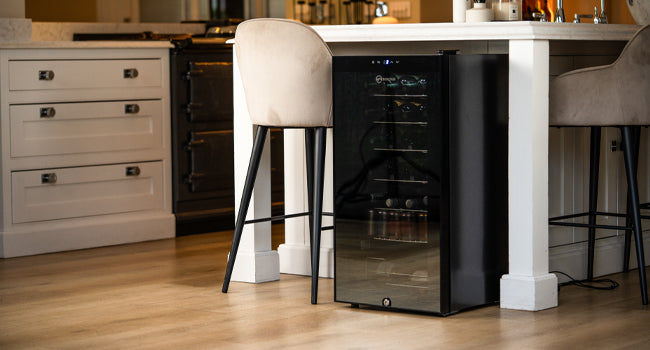
When choosing a drinks fridge, beer fridge, or wine cooler, one important factor to consider is the type of cooling system it uses. Most compact fridges rely on either thermoelectric cooling or compressor cooling. Both are designed to keep drinks chilled, but they work in different ways and suit different environments.
Thermoelectric fridges use the Peltier effect to transfer heat from inside the fridge to the outside. Because they do not use a compressor or refrigerant, they have fewer moving parts. One of their main advantages is that they run very quietly, making them ideal for bedrooms, offices, or living spaces where noise levels matter.
Thermoelectric cooling also produces minimal vibration, which is often preferred for storing wine. For this reason, many compact wine coolers use thermoelectric systems. However, these fridges rely on the surrounding room temperature to work efficiently and typically cool to a certain amount below the ambient temperature. They therefore perform best in stable indoor environments.
Compressor fridges use the same cooling technology found in traditional household refrigerators. A compressor circulates refrigerant through the system, removing heat from inside the fridge and releasing it outside. This allows compressor fridges to achieve stronger and more consistent cooling, even when the surrounding environment is warm.
Because of this, compressor cooling is commonly used in beer fridges, larger drinks fridges, and high-performance beverage coolers. The main drawback is that compressor models can produce slightly more noise and vibration as the compressor cycles on and off.
Both cooling systems are used in wine coolers. Thermoelectric models are often chosen for quiet operation and minimal vibration, while compressor wine coolers provide more powerful temperature control, especially in warmer rooms.
In simple terms, thermoelectric fridges are ideal for quiet indoor spaces and smaller appliances, while compressor fridges offer stronger cooling performance for larger drink fridges or warmer environments. Choosing the right option depends on where the fridge will be used and how cold you need your drinks to be.


Leave a comment
This site is protected by hCaptcha and the hCaptcha Privacy Policy and Terms of Service apply.