

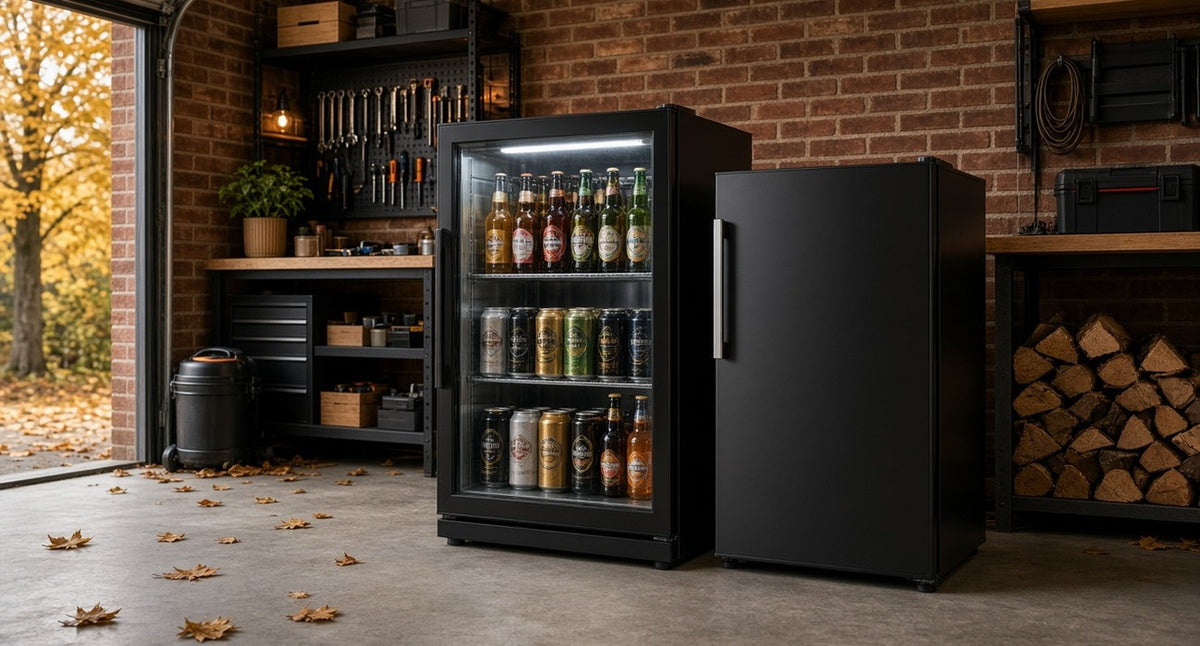
Garages, sheds and garden rooms are the most popular overflow spaces in British homes. They are perfect for a spare garage freezer full of batch cooking, a garage fridge for the garden bar, or extra cold storage for parties. But an outbuilding is not a kitchen: temperatures in a fridge in shed UK or unheated garage setting can swing from chilly winter nights to over 30°C under a tin roof in July. Before you plug in, it pays to understand climate classes, how they relate to real-world manufacturer testing, and what to look for in a garage-ready freezer or beer fridge.
The Short Answer
Yes, you can put a fridge or freezer in a UK garage or shed, provided the space is dry, ventilated, protected from rain and weather, and the appliance is either rated or manufacturer-tested for the environment. Problems typically arise when an untested indoor appliance is placed in temperatures outside the range it was designed for. Too hot, and the compressor runs constantly. Too cold, and a combined fridge-freezer's single thermostat may stop calling for cooling altogether, letting the freezer section thaw.
What Are Climate Classes?
Every domestic compressor fridge and freezer carries a formal climate class on the rating plate inside the cabinet or on the back panel, defining the standardised band of ambient (room) temperatures under which the appliance is rated.
| Climate class | Rated ambient range | Typical location |
|---|---|---|
| SN (Extended Temperate) | +10°C – +32°C | Cool rooms, utility rooms |
| N (Temperate) | +16°C – +32°C | Heated kitchens |
| ST (Subtropical) | +16°C – +38°C | Warm kitchens, conservatories |
| T (Tropical) | +16°C – +43°C | Hot climates |
SN is the lowest-temperature standard climate class, starting at +10°C, while N, ST and T all start at +16°C. An appliance rated SN-T covers the widest standard spread, from +10°C to +43°C. Crucially, there is no separate standard domestic climate class specifically covering operation below +10°C.
Because a climate class defines a standardised test and rating range rather than an absolute cut-off temperature below which every appliance will stop working, a manufacturer may separately test and validate a product for additional low-ambient garage capability beyond its standard climate-class label.
Climate Class vs Real-World Garage Testing
Standard refrigeration climate classes specify the ambient temperature ranges under which an appliance is formally rated. The lowest standard classification, SN, begins at +10°C.
However, climate classification and additional manufacturer testing are not the same thing. Some refrigeration appliances can operate successfully outside their standard climate-class range when specifically designed or tested for those conditions.
At Subcold, we have undertaken long-term, real-world garage suitability testing with our APEX beer fridge and ECO-F freezer ranges, and the APEX range is also outdoor-approved under dry, sheltered conditions as tested internally by Subcold. This practical testing supports our recommendations for suitable UK garage, sheltered outbuilding and dry covered outdoor installations, subject to appropriate positioning, ventilation and environmental conditions.
Customers should always consider the actual conditions of their garage or outdoor space, including extreme temperatures, moisture and ventilation.
Why Cold Winters Affect Combined Fridge-Freezers
Most people worry about summer heat, but in the UK the bigger challenge for standard kitchen appliances is winter cold. A standard fridge thermostat measures the temperature inside the fridge cabinet. When an unheated garage drops to a low winter temperature, the fridge compartment is already cold, so the compressor rarely switches on. In a combined single-thermostat fridge-freezer, the freezer compartment only receives cooling when the fridge thermostat calls for the compressor to run, meaning frozen food can slowly thaw.
This is why a dedicated garage freezer or a dedicated garage fridge that has been tested for garage environments is a far better outbuilding choice than a combined kitchen fridge-freezer: each appliance has its own dedicated thermostat monitoring the single compartment that matters.
Summer Heat Under a Tin Roof
On the other side of the year, a single-skin garage or shed can easily exceed 30°C. Heat makes the compressor work harder and longer, raising running costs and wear. Keep your garage fridge or freezer out of direct sun, leave the manufacturer's recommended gap around the cabinet for air to circulate, and never box it in tightly against a hot wall.
Damp, Rain and Ventilation
Condensation and damp are the silent enemies of electrical appliances. Choose a dry, well-ventilated space with a sound roof, raise the appliance off a damp concrete floor if needed, and use a properly installed socket rather than a long extension lead. A covered patio, pergola or outdoor kitchen also requires a fridge specifically tested and approved for dry covered outdoor use.
Best Subcold Fridges for Garages, Garden Bars and Patios: The Apex Series
The Apex70 and Apex95 are Subcold's indoor and outdoor beer fridges. Subcold has carried out long-term, real-world garage suitability testing on the APEX range, and both models are also approved for outdoor use under dry, sheltered conditions based on Subcold's internal testing. In addition, both carry an IPX4 splash-resistance rating to protect against water splashes on a covered patio, in a garden bar, an outdoor kitchen or a garage.
- Apex70: around 79 kWh per year on the product listing, a compact footprint for smaller garden bars, covered patios and garages.
- Apex95: around 81 kWh per year and 41 dB, extra capacity for bottles, cans and mixers when you entertain.
- Please note: the Apex range does not have a lock, so position it in a secure space if children or neighbours have access.
Tip: The APEX range is approved for outdoor use under dry, sheltered conditions (such as a covered patio, garden bar or pergola) as tested internally by Subcold, and IPX4 denotes protection against splashing water (not low-temperature rating, submersion or direct driving rain). Always site an Apex under a dry roof, canopy or sheltered garage and keep electrical connections dry.
Best Freezers for Garages and Sheds: The Eco-F Series
For dependable extra frozen storage, the Subcold Eco-F range gives you a dedicated garage-ready freezer cabinet with its own thermostat. Alongside their published climate-class specification, Subcold has conducted long-term, real-world garage suitability testing on the ECO-F range, confirming their suitability for appropriate UK garage and sheltered outbuilding installations.
| Model | Format | Listed energy use | Ideal for |
|---|---|---|---|
| Eco35F | Compact mini freezer | 147 kWh/year | Ice packs, ice cubes, small overflow |
| Eco60F | Tabletop freezer | 150 kWh/year | Batch cooking, frozen desserts |
| Eco90F | Undercounter freezer | 164 kWh/year | Family overflow, bulk buying |
Because they are dedicated freezers backed by Subcold's long-term garage suitability testing, they avoid the classic combined fridge-freezer winter problem. Always keep the cabinet dry and well ventilated, and ensure your outbuilding is sheltered from extreme weather and moisture.
Setting Up an Outbuilding Fridge or Freezer: Checklist
- Check both the published climate class and any additional model-specific manufacturer testing or operating recommendations for garage, outbuilding and dry outdoor use.
- Choose a dry, weather-protected, ventilated spot out of direct sunlight.
- Use a fixed RCD-protected socket installed by a qualified electrician; avoid daisy-chained extension leads.
- Leave the recommended ventilation gaps around the back, sides and top.
- Stand the appliance on a level, solid surface and adjust the front feet so the door closes and seals properly.
- After moving, let a compressor appliance stand upright for several hours before switching on.
- Place a min/max thermometer inside for the first week to confirm temperatures stay where you want them.
- Defrost manual-defrost freezers regularly; a thick ice layer wastes energy.
Garage Fridge Mistakes to Avoid
- Putting an untested combined kitchen fridge-freezer into an unheated outbuilding without checking manufacturer garage-suitability recommendations.
- Leaving a fridge or freezer on a damp floor or under a leaking roof.
- Pushing the cabinet tight against a wall, blocking the condenser and ventilation airflow.
- Storing paint, fuel or chemicals next to the appliance.
- Using an indoor-only fridge outdoors, or leaving an outdoor fridge exposed to direct rain without dry overhead shelter.
Frequently Asked Questions
Will my freezer stop working in a cold garage?
A dedicated freezer is far more suitable than a combined fridge-freezer because its thermostat monitors the freezer cabinet directly. While standard domestic climate classes start at +10°C (SN) or +16°C (N, ST, T), Subcold's ECO-F freezer range has undergone long-term, real-world garage suitability testing to support reliable use in suitable UK garages and sheltered outbuildings.
Can I keep a beer fridge in a shed or outdoor bar?
Yes, if the space is dry, sheltered, ventilated and powered by a safe, properly installed supply. Subcold's Apex70 and Apex95 have undergone long-term real-world garage suitability testing, are approved for outdoor use under dry, sheltered conditions as tested internally by Subcold, and also feature IPX4 splash resistance for covered patios and garden bars.
Do garage fridges cost more to run?
In hot summer months, yes, because the compressor works harder. In winter they often run less. Placement out of direct sun with good airflow makes the biggest difference.
Choose the Right Cold Storage for Your Outbuilding
A garage or shed can be the perfect home for extra cold storage when you choose an appliance tested for the environment. Backed by Subcold's long-term garage and internal dry-outdoor suitability testing, the Apex70 and Apex95 are built for garages, garden bars and dry covered patios, while the Eco35F, Eco60F and Eco90F give you dedicated garage-ready freezer space. Explore the full range of Subcold beer fridges or read our Complete Buying Guide to compare every series.

Leave a comment
This site is protected by hCaptcha and the hCaptcha Privacy Policy and Terms of Service apply.