

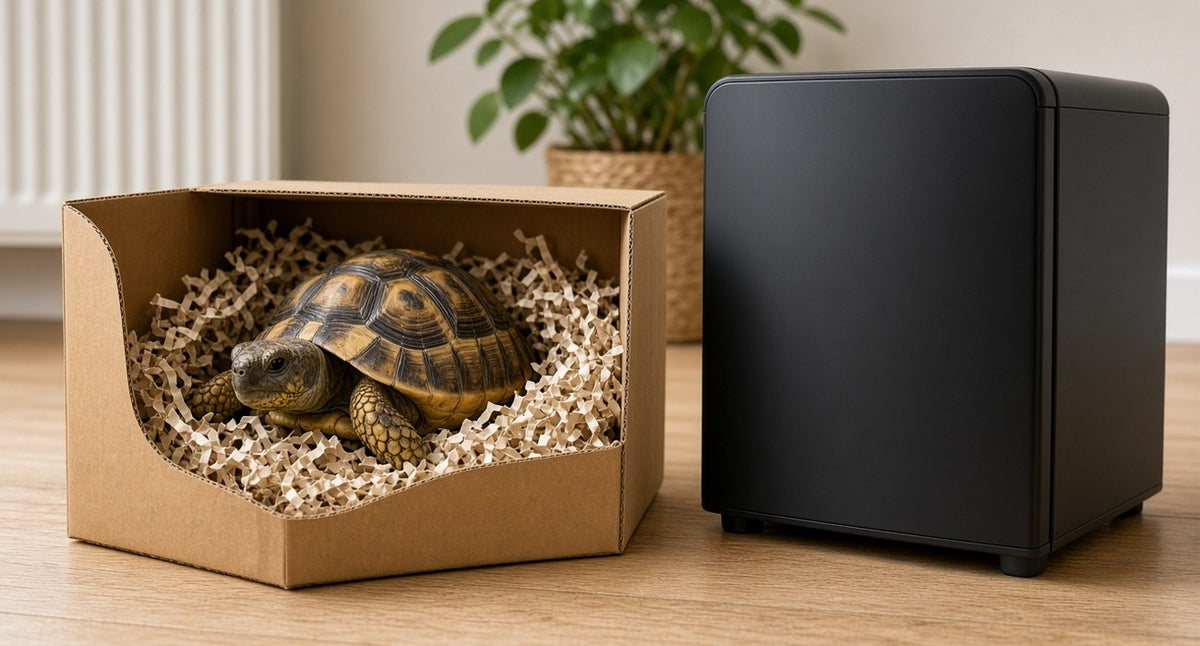
Every autumn across the UK, our customer support team receives dozens of enquiries from tortoise owners asking the same question: “Which Subcold fridge is best for hibernating my tortoise over winter, and what are the exact internal shelf dimensions?”
With UK autumn and winter temperatures becoming milder and far more unpredictable, traditional hibernation spots like garden sheds, garages, and lofts often fluctuate dangerously between too warm (>10°C) and below freezing (<0°C). As a result, many UK reptile vets and specialist keepers use a dedicated, larder-style compact fridge (with no ice box) to provide a stable, insulated microclimate around 4°C to 6°C (target 5°C).
In this comprehensive guide, we cover the key differences between compressor and thermoelectric fridges for tortoise hibernation, share the exact internal and shelf-depth dimensions (including above and below the rear compressor step), and walk through the essential preparation and monitoring steps every tortoise owner should follow.
⚠️ Important Welfare & Veterinary Disclaimer
Subcold refrigerators and chillers are consumer household appliances designed and certified for food and beverage storage — they are not certified medical or veterinary incubators. Not all tortoise species hibernate (for example, Leopard, Sulcata, Indian Star, and Red-footed tortoises must never be hibernated), and an underweight or unwell tortoise should never be put into hibernation. Always consult an exotic/reptile veterinarian and follow Tortoise Trust guidelines before hibernating your tortoise. Never rely solely on a fridge’s built-in thermostat or display: always run and test the fridge empty (with water bottles for thermal ballast) for at least 48–72 hours beforehand using an independent dual-probe digital min/max thermometer with high/low temperature alarms.
Why Tortoise Owners Use a Dedicated Mini Fridge for Hibernation
For hibernating Mediterranean species (such as Hermann’s, Horsfield’s, Spur-thighed, and Marginated tortoises), reptile specialists recommend a steady hibernation temperature between 4°C and 6°C (with 5°C as the ideal target):
- Above 8°C–10°C: The tortoise’s metabolic rate increases, causing them to wake up and burn through vital fat and hydration reserves without food.
- Below 0°C: Freezing temperatures can cause tissue damage, blindness, or fatal injury.
A dedicated compact fridge solves three major problems at once:
- No Ice Box / Freezer Compartment: Standard household under-counter or table-top larder fridges (such as our Eco50, Eco75, and Eco100) include an internal top chiller/ice box. We do not recommend fridges with an internal ice box for tortoise hibernation, as the cold plate can create sub-zero pockets directly beneath it. Dedicated drinks, beer, and wine fridges have a pure cooling chamber with zero ice box.
- Protection from Sudden UK Weather Swings: Placed indoors in a steady room, a dedicated fridge prevents mild winter spells from waking your tortoise prematurely.
- Hygienic, Dedicated Space: Keeping a separate compact fridge avoids sharing space with household food, prevents frequent family door-openings, and eliminates accidental knocks.
Compressor vs Thermoelectric Fridges: Critical Advice Before You Buy
One of the most common questions our team gets asked on the phone and via email is whether to choose a Thermoelectric mini fridge (such as our Subcold Aire40) or a Compressor fridge (such as our Subcold Cave50-G, Super50 LED, or Viva16 LED).
As we explain in our Thermoelectric vs Compressor Fridges guide, the two cooling technologies work very differently — and choosing the right one depends entirely on the room where you plan to keep the fridge:
1. Compressor Fridges (Cave, Super & Viva Series) — Best for Consistent Temperature Stability
- How they work: Use a traditional R600a refrigeration compressor (with no ice box) to actively remove heat from the cabinet.
- Why we recommend them first for tortoise hibernation: Compressor cooling is much stronger and far less affected by minor changes in the surrounding room temperature. If your house cools down overnight when the central heating turns off and warms up during the day, a compressor fridge is much better at holding a steady 5°C.
- Important placement rule: Standard indoor compressor fridges (Climate Class N/SN/ST) must still be kept indoors in a normal room (16°C–32°C) — never in an unheated garage or shed where winter temperatures drop below 10°C.
2. Thermoelectric Fridges (Aire20, Aire30 & Aire40 Series) — Vibration-Free, But Requires a Steady Heated Room
- How they work: Our Aire20, Aire30, and Aire40 models (both solid-door and -G glass-door versions) use solid-state Peltier thermoelectric (electronic chip) cooling with an internal circulation fan and an internal manual thermostat dial (Min / Middle / Max, rated 3°C–15°C).
- Why some tortoise owners choose them: Because there is no compressor, there is zero compressor kick-in vibration, ultra-quiet operation (40dB), a built-in door lock, and a completely rectangular interior with no rear compressor step at the bottom.
- ⚠️ The Essential Rule for Thermoelectric Models: Thermoelectric cooling chills relative to the surrounding room temperature (typically up to 15°C–18°C below ambient). If the room temperature rises and falls by several degrees between day and night, the internal fridge temperature will drift with it. Therefore, if you choose an Aire model, it must be placed in an indoor room with a very stable, thermostatically controlled temperature (ideally 16°C–20°C). If your room temperature fluctuates, choose a compressor model (Cave50, Cave50-G, Super50, or Viva16) instead.
Top Subcold Fridges Recommended by Tortoise Owners (With Exact Internal & Shelf Dimensions)
When sizing a fridge for tortoise hibernation, always check the usable shelf depth rather than just the overall external dimensions. On compressor models, the compressor sits at the lower rear of the cabinet, creating an internal “step” on the bottom floor. Your tortoise’s hibernation box should sit flat on the upper shelf (above the compressor step) where you get the full internal depth, while the narrower floor space in front of the step is ideal for standing bottles of water as thermal ballast.
1. Best Overall Value & Temperature Stability: Subcold Cave50-G (Glass Door) & Cave50 (Solid Door)
The Subcold Cave50 series is our #1 most enquired-about range for tortoise hibernation. It uses reliable compressor direct cooling with no ice box, runs at a whisper-quiet 39dB, and easily accommodates standard tortoise hibernation boxes (such as a 310 × 225 × 125 mm box) on the upper shelf with plenty of airflow space around the sides.
- Cooling System: Compressor (Direct Cooling, R600a, no ice box)
- Temperature Range: 3°C–15°C on Cave50-G Glass Door | 0°C–8°C on Cave50 Solid Door (manual internal thermostat dial)
- Overall Internal Dimensions: 380mm (W) × 340mm (D) × 419mm (H)
- Upper Shelf Area (Above Rear Compressor Step): 380mm (W) × 340mm (D) × 230mm (H) (or 133mm height between the two shelf positions if both shelves are fitted; main wire shelf measures 372mm W × 242mm D)
- Bottom Floor Area (In Front of Compressor Step): 380mm (W) × 200mm (D) × 190mm (H) (ideal for water bottles to stabilise temperature)
- Door Storage Note: The Cave50-G Glass Door (£149.99) has a completely flat inner door with no door racks, and allows you to read an internal digital thermometer through the glass without opening the door (simply drape a dark breathable cloth over the front glass to keep the chamber dark). On the Cave50 Solid Door (£129.99), the inner door shelving is removable if you need extra clearance.
- Need More Height for Two Boxes? Step up to the Subcold Cave60-G (£169.99) or Cave60 Solid Door (£134.99), which keeps the same 380mm (W) × 340mm (D) footprint but increases internal height to 526mm.
2. Best Compressor Fridge with Built-In Lock & Extra Depth: Subcold Super50 LED & Super65 LED
If you want compressor cooling stability plus a built-in key lock (essential if you have young children in the house) and extra internal depth, our Super LED range is a longstanding favourite among UK tortoise keepers.
- Cooling System: Compressor (R600a, no ice box) with manual thermostat dial (3°C–18°C)
- Subcold Super50 LED (£159.99) Internal Dimensions: 357mm (W) × 385mm (D) × 430mm (H) (46L net, 3 removable chrome wire shelves, integrated lock & key, 42dB)
- Subcold Super65 LED (£199.99) Internal Dimensions: 385mm (W) × 335mm (D) × 528mm (H) (60L net, 3 removable chrome wire shelves, integrated lock & key, 39dB)
- Subcold Super35 LED (£154.99) Internal Dimensions: 300mm (W) × 315mm (D) × 440mm (H) (33L net, 2 removable shelves, integrated lock & key — ideal for smaller juvenile hibernation boxes)
3. Best Compressor Fridge with Degree-by-Degree Digital Touch Control: Subcold Viva16 LED & Viva20 LED
Many tortoise keepers ask for a fridge that combines compressor cooling stability with a digital touch thermostat (so you can set the target temperature in 1°C increments rather than turning a manual dial) and an automatic child-lock control panel. Our Viva LED compressor range ticks every box:
- Cooling System: Compressor (R600a, no ice box) with Smart-Touch Digital Thermostat (3°C–18°C in 1°C steps) and auto-locking touch panel
- Subcold Viva16 LED (£159.99) Internal Dimensions: 340mm (W) × 340mm (D) × 450mm (H) (42L net, 39dB, UV-tempered mirrored glass door, physical lock & 2 keys, removable wire shelves; flat additional shelves available via Viva Universal Flat Shelf)
- Subcold Viva20 LED (£179.99) Internal Dimensions: 340mm (W) × 340mm (D) × 528mm (H) (53L net, 39dB, physical lock & 2 keys)
4. Best Vibration-Free Thermoelectric Option (For Steady Indoor Rooms Only): Subcold Aire40, Aire30 & Aire20
If your fridge will live in a thermostatically controlled indoor room (such as a bedroom, study, or hallway kept at a steady 16°C–20°C) and you want zero compressor vibration, a built-in key lock, and a flat floor with no compressor step, the Subcold Aire range is available in both pitch-dark solid doors and dual-glazed glass doors:
- Aire40 Solid Door (£114.99) / Aire40-G Glass Door (£134.99): 40L volume | Internal: 330mm (W) × 257mm (D) × 428mm (H) | 2 removable tempered glass shelves | Lock & 2 keys
- Aire30 Solid Door (£129.99) / Aire30-G Glass Door (£149.99): 30L volume | Internal: 325mm (W) × 226mm (D) × 390mm (H) | 2 removable tempered glass shelves | Lock & 2 keys
- Aire20 Solid Door (£109.99) / Aire20-G Glass Door (£124.99): 20L volume | Internal: 330mm (W) × 257mm (D) × 250mm (H) | 1 removable tempered glass shelf | Lock & 2 keys
- Note on Solid Door Aire models: Solid-door Aire models include internal door racks, which reduces the front-to-back shelf depth compared to the glass-door -G models (which have a flat inner glass door). Always measure your hibernation box depth before ordering!
Quick Comparison Table: Subcold Models for Tortoise Hibernation
| Model | Cooling System | Temp Range & Control | Internal Dimensions (W × D × H) | Door Type & Lock | Noise | UK Price |
|---|---|---|---|---|---|---|
| Cave50-G | Compressor (No ice box) | 3–15°C (Manual Dial) | 380 × 340 × 419 mm (Upper shelf: 380 × 340 × 230 mm) |
Glass Door (No lock) | 39dB | £149.99 |
| Cave50 Solid | Compressor (No ice box) | 0–8°C (Manual Dial) | 380 × 340 × 419 mm (Removable door storage) |
Solid Door (No lock) | 39dB | £129.99 |
| Cave60-G / Cave60 | Compressor (No ice box) | 3–15°C (-G) / 0–8°C (Solid) | 380 × 340 × 526 mm | Glass or Solid (No lock) | 39dB | £134.99–£169.99 |
| Super50 LED | Compressor (No ice box) | 3–18°C (Manual Dial) | 357 × 385 × 430 mm | Glass Door + Lock & Key | 42dB | £159.99 |
| Super65 LED | Compressor (No ice box) | 3–18°C (Manual Dial) | 385 × 335 × 528 mm | Glass Door + Lock & Key | 39dB | £199.99 |
| Viva16 LED | Compressor (No ice box) | 3–18°C (Digital Touch) | 340 × 340 × 450 mm | UV Glass + Lock & Key | 39dB | £159.99 |
| Aire40 / Aire40-G | Thermoelectric (Steady indoor room only) | 3–15°C (Manual Dial) | 330 × 257 × 428 mm (Flat floor, no rear step) |
Solid or Glass + Lock & Key | 40–41dB | £114.99 / £134.99 |
| Aire30 / Aire30-G | Thermoelectric (Steady indoor room only) | 3–15°C (Manual Dial) | 325 × 226 × 390 mm | Solid or Glass + Lock & Key | 40–41dB | £129.99 / £149.99 |
| Aire20 / Aire20-G | Thermoelectric (Steady indoor room only) | 3–15°C (Manual Dial) | 330 × 257 × 250 mm | Solid or Glass + Lock & Key | 40dB | £109.99 / £124.99 |
Step-by-Step Guide: How to Prepare a Subcold Fridge for Tortoise Hibernation
Step 1: Let the Fridge Stand Upright & Position Indoors
- After delivery, place your fridge on a firm, level indoor surface and allow it to stand upright unplugged for at least 2 hours so the compressor oil and refrigerant settle after transit.
- Place the fridge in an indoor room with a steady ambient temperature (16°C–22°C), away from radiators and direct sunlight.
- Leave at least 3–5 cm of ventilation clearance on each side and the top, and 5–10 cm at the rear so heat can dissipate freely. Never enclose a freestanding fridge inside a closed cupboard.
Step 2: Add Sealed Water Bottles as “Thermal Ballast”
- An empty fridge loses its cold air rapidly when you open the door and experiences wider temperature swings as the cooling cycle turns on and off.
- Place 2 to 4 sealed bottles of water on the bottom floor (in front of the compressor step) or around the edges of the cabinet. Once chilled, water acts as a thermal buffer (“thermal ballast”), smoothing out the fridge’s natural cooling cycle and keeping the temperature around 5°C remarkably stable.
Step 3: Fit an Independent Dual-Probe Min/Max Thermometer & Alarm
- Never rely solely on the thermostat dial or door readout. Cold air sinks, meaning the bottom of any fridge can be 1°C–2°C cooler than the top shelf.
- Place a calibrated digital min/max thermometer with an external wired probe directly inside the empty dummy hibernation box on the exact shelf your tortoise will occupy.
- We strongly recommend choosing a thermometer with an audible high/low alarm (set to alert you if the temperature drops below 3.5°C or rises above 7.5°C). The thin sensor wire passes neatly through the soft magnetic rubber door gasket without breaking the seal.
Step 4: Run a 48–72 Hour Dry Run Before Hibernation
- Switch the fridge on (with your water bottles and dummy hibernation box inside) and monitor the min/max readings for at least 48 to 72 hours before your tortoise finishes their pre-hibernation wind-down.
- Make small adjustments to the thermostat and wait 12–24 hours between tweaks until the temperature inside the box holds a steady 4.5°C–5.5°C over a full day-and-night cycle.
Step 5: Ensure the Hibernation Box Doesn’t Touch the Rear Cooling Plate
- On direct-cooling compressor fridges (Cave, Super, Viva) and thermoelectric fridges (Aire), the cold evaporator plate sits inside the rear wall of the fridge.
- Always leave at least 2–3 cm of clear space between the back of your tortoise’s hibernation box and the back wall of the fridge so air circulates freely and condensation or frost on the rear wall never touches the box.
- If you choose a glass-door model, switch the internal LED light OFF and hang a dark, breathable cover or towel over the front glass door (taking care never to cover the side, top, or rear ventilation areas) so your tortoise remains in complete darkness.
Step 6: Daily Air Exchange & Regular Weight Checks
- Modern fridges have airtight magnetic door seals. Even though a hibernating tortoise at 5°C has a very low respiration rate, you should open the fridge door for 1–2 minutes every day (or every 1–2 days as advised by your vet) to waft fresh, oxygenated air into the cabinet and check your min/max thermometer readings.
- Weigh your tortoise regularly on digital kitchen scales according to your vet’s hibernation chart to ensure weight loss remains within safe limits (typically ~1% of body weight per month).
Frequently Asked Questions (FAQ)
Can I remove the door storage on the Subcold Cave50 Solid Door fridge?
Yes. On the solid-door Subcold Cave50 and Cave60, the inner door storage brackets can be removed. Alternatively, if you prefer a completely flat inner door straight out of the box, choose the Cave50-G, Cave60-G, or Super50 LED glass-door models.
Will a hibernation box measuring 310mm (W) × 225mm (D) × 125mm (H) fit inside the Cave50-G?
Yes, comfortably on the upper shelf. In the Cave50-G and Cave50, the upper section above the rear compressor step measures 380mm (W) × 340mm (D) × 230mm (H) (or 133mm height between shelves if both shelves are installed), giving your 310 × 225 × 125 mm box plenty of room to sit flat with airflow clearance on all sides. The bottom floor in front of the compressor step measures 380mm (W) × 200mm (D) × 190mm (H), which is ideal for water bottles.
Why shouldn’t I use a Subcold Eco50, Eco75, or Pro4/6/10/15 mini fridge?
Our Eco50, Eco75, and Eco100 table-top and under-counter fridges feature an internal top chiller/ice box compartment, which can create sub-zero cold spots directly underneath the chiller plate. Meanwhile, our portable Pro, Ultra, and Classic 4L–15L personal coolers are designed for skincare and cans without a thermostat dial for 5°C control. Stick to our larder-style compressor (Cave, Super, Viva) or thermoelectric (Aire) models.
Can I put my tortoise hibernation fridge in a garage or shed?
No. Both our compressor drinks fridges (Cave, Super, Viva) and thermoelectric mini fridges (Aire) are designed for indoor rooms with an ambient temperature of 16°C–32°C. Placing a standard fridge in an unheated garage or shed where winter temperatures drop below 10°C (or below 5°C) can cause the thermostat to stop cycling properly or let the internal cabinet drop toward freezing.
Need help checking whether your tortoise’s hibernation box will fit a specific Subcold model? Browse our full Beer & Drinks Fridges and Table-Top Mini Fridges collections, or reach out to our team via the Subcold Support Centre with your box measurements and we’ll be happy to check the exact shelf clearance for you.


Leave a comment
This site is protected by hCaptcha and the hCaptcha Privacy Policy and Terms of Service apply.