

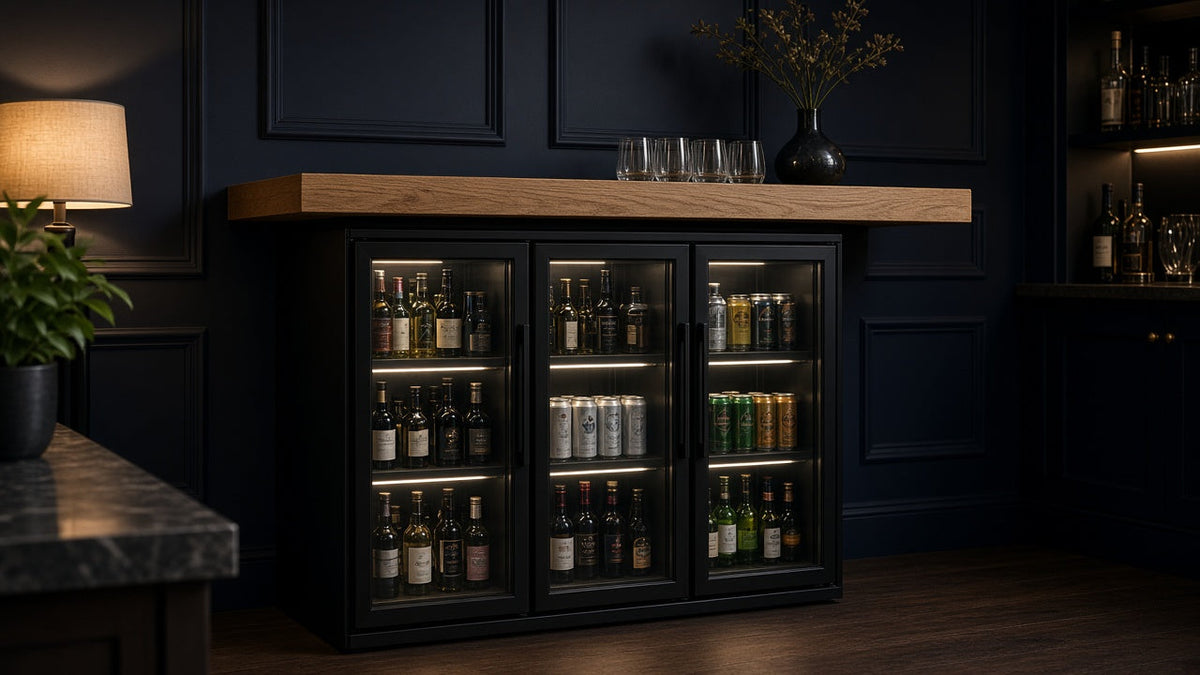
Header image: AI-generated illustration, not a specific product.
Buying guide
A back bar fridge is a commercial, glass-door bottle cooler that sits behind or under a bar counter, keeping drinks cold and on show. Pubs, bars, restaurants, hotels and clubs use them for fast service; some premium home bars do too. This guide covers types, sizing, doors, running costs and ventilation, then compares real models.
Key takeaways
Contents
- What is a back bar fridge?
- Types of back bar cooler
- How to choose the right size
- Sliding vs hinged doors
- Energy use and running costs
- Temperature and ventilation
- Choosing for your venue
- Compare Empire back bar coolers
- Installation and maintenance
- Common buying mistakes
- FAQs
What is a back bar fridge?
It is a commercial bottle cooler built for a bar: glass doors to show stock, adjustable shelves, and a cabinet made to be opened all day. Most are under-counter height so staff can grab drinks without turning far.
| Term | Usually means |
|---|---|
| Back bar fridge / cooler | Glass-door cooler behind a bar, often under-counter |
| Bottle cooler | Any fridge for bottled and canned drinks; can be under-counter or upright |
| Commercial drinks fridge | Broad term for fridges built for trade use |
| Undercounter bar fridge | Fits beneath a worktop, usually under 900mm tall |
| Upright display fridge | Full-height glass-door cooler, often 1.8m or more |
The terms overlap but are not identical, so check the dimensions, not the name. A domestic mini fridge is built for home use and lighter door opening; a commercial cooler is built for service. If you want a fridge mainly for home, start with our fridge buying guide.
Types of back bar cooler
Door count sets the width. Typical widths are about 600mm (single), 900mm (double) and 1350mm (triple), based on the Empire range below; other brands vary.
| Style | Suits | Watch for |
|---|---|---|
| Single door | Small bars, cafés, restaurant service points | Limited range of lines |
| Double door | The standard pub back bar | Hinged doors need swing space |
| Triple door | Busy bars, clubs, events | 1.35m+ of wall, heavier to move |
| Sliding doors | Narrow aisles behind the bar | Only part of the cabinet opens at once |
| Hinged doors | Bars with room in front | Door arc can block staff |
| Low height (835mm) | Counters lower than standard | Check the low model's own specs |
| Upright | More stock at eye level, wall positions | Height, weight and access route |
Glass doors sell stock and speed up picking. Solid doors hide stock and are more common on storage fridges; every Empire model listed here has glass doors.
How to choose the right size
Capacity in litres is gross cabinet volume. Bottle shape, shelf spacing and air gaps decide how many drinks actually fit, so a 330L cooler will not hold 330 litres of bottles. If you need a target number, tell us what you stock and we will check.
Measuring checklist
- Narrowest width of the space
- Height under the counter at both ends
- Depth, minus skirting, pipes and sockets
- The stated ventilation gap on every side
- Door swing or sliding clearance in front
- Space for staff to stand and restock
- Doorways, stairs and corners on the route in
- A dedicated socket within reach
Example: Empire's under-counter listings recommend a 10mm gap on all sides. A 900mm-wide cooler then needs at least 920mm; an 895mm-tall one needs 905mm under the counter.
Sliding vs hinged doors
Neither is better everywhere. Pick the one that fits your aisle and how staff work.
| Factor | Sliding | Hinged |
|---|---|---|
| Space in front | No swing arc | Needs room for the door to open |
| Ease of use | Open one section at a time | Whole compartment opens at once |
| Restocking | Slower for full trays | Easier for bulk loading |
| Cleaning | Keep tracks clear of debris | Check hinges and gaskets |
| Sealing | Check doors close fully | Self-closing doors help |
| Busy service | Good in tight runs | Good where aisles are wide |
Empire model codes help: H means hinged, S sliding, SC sliding and low height. Both door types come in 1350mm, for example the Empire CL-320H (hinged) and Empire CL-320S (sliding).

Energy use and running costs
Commercial display fridges in Great Britain carry an A–G energy label. The useful number is energy use per 24 hours (kWh/24h), which makes models comparable.
kWh/24h × 365 × your price per kWh = yearly cost
| Model | Class | kWh/24h | kWh/yr | £/yr* |
|---|---|---|---|---|
| Empire CL-130H | A | 0.96 | 350 | £92.23 |
| Empire CL-210S | B | 1.55 | 566 | £148.91 |
| Empire CL-210SC | A | 1.09 | 398 | £104.71 |
| Empire CL-320H | B | 1.97 | 719 | £189.25 |
| Empire CL-320S | B | 2.24 | 818 | £215.19 |
| Empire CL-320SC | B | 2.19 | 799 | £210.39 |
*Assumes 26.32p/kWh (Ofgem price cap unit rate, Oct–Dec 2026). Business tariffs differ, so use your own rate. Class and kWh are as stated by Empire Supplies; real use rises with heat and door opening. Empire does not state energy figures for its uprights. More detail: fridge running costs.
Temperature and ventilation
Behind a bar it gets warm: lights, glasswashers, people and closed-in counters all add heat. A cooler working in hot air, with doors opened constantly, runs harder and may struggle to hold temperature.
- Ranges: Empire states 0–10°C for its under-counter models, CL-310H and CL-510H.
- Climate class: this is the room temperature a fridge is designed to work in. The models in this guide are climate class ST (16–38°C room temperature). Keep a hot bar within that range.
- Airflow: keep the stated gaps clear. Do not box in a freestanding cooler.
- Restocking: load warm stock gradually and allow time to pull down.
These coolers are for drinks. Empire does not list them for outdoor use, food or medical storage. For serving temperatures, see the perfect temperature for beers.
Choosing for your venue
| Venue | Usually works | Why |
|---|---|---|
| Pub | Double or triple, sliding if narrow | High volume, tight bar runs |
| Cocktail bar | Low-height or single units by stations | Mixers close to each bartender |
| Restaurant | Single or double | Wine and soft drinks near service |
| Hotel bar | Double, hinged if space allows | Display matters, lower volume |
| Sports or social club | Triple door | Big peaks at match or event times |
| Premium home bar | Single or double | Built for commercial use, may be noticeable in quiet rooms |
Compare Empire back bar coolers
Empire is an independent brand, made and supplied by Empire Supplies and sold by Subcold as a UK retailer. Figures are from Empire Supplies' published specifications. Climate class ST (16–38°C room temperature) is as advised by Subcold.
| Model | Format | Doors | Capacity | W x D x H | Temp | Class, kWh/24h | Climate class |
|---|---|---|---|---|---|---|---|
| Empire CL-130H | Under-counter | 1 hinged | 138L | 600 x 530 x 895mm | 0–10°C | A, 0.96 | ST |
| Empire CL-210S | Under-counter | 2 sliding | 208L | 900 x 520 x 895mm | 0–10°C | B, 1.55 | ST |
| Empire CL-210SC | Under-counter, low height | 2 sliding | 208L | 900 x 530 x 835mm | 0–10°C | A, 1.09 | ST |
| Empire CL-320H | Under-counter | 3 hinged | 330L | 1350 x 520 x 895mm | 0–10°C | B, 1.97 | ST |
| Empire CL-320S | Under-counter | 3 sliding | 330L | 1350 x 520 x 895mm | 0–10°C | B, 2.24 | ST |
| Empire CL-320SC | Under-counter, low height | 3 sliding | 330L | 1350 x 520 x 835mm | 0–10°C | B, 2.19 | ST |
| Empire CL-310H | Upright | 1 hinged | 295L | 600 x 530 x 1820mm | 0–10°C | Not stated | ST |
| Empire CL-510H | Upright | 2 hinged | 466L | 900 x 530 x 1820mm | 0–10°C | Not stated | ST |
Empire manufacturer warranty. Delivery options and times are shown at checkout.

Empire CL-130H
Single hinged door, 600mm wide. A compact start for restaurants and small bars.
View CL-130H


Need more height? The Empire CL-310H and Empire CL-510H are upright coolers at 1820mm. For larger uprights, see tall drinks fridges; wine lists may suit the Empire CL-375WD wine cooler.
Installation and maintenance
- Check the route in before ordering. Uprights are tall and heavy.
- Stand it level, on a firm floor, away from ovens, radiators and direct sun.
- Use a suitable socket, not an extension lead.
- Follow the manual for any settling time before switching on.
- Wipe door seals regularly and replace any that split.
- Keep vents and condenser areas free of dust, as the manual directs.
- Keep access to the back for cleaning.
Always follow the manufacturer's instructions over general advice. For placement in garages and outbuildings, read fridges in garages and sheds.
Common buying mistakes
- No clearance: fitting the cabinet exactly, with no ventilation gap.
- Wrong door: hinged doors that block a narrow aisle.
- Buying on litres: assuming capacity equals bottle count.
- Ignoring heat: a hot, enclosed bar is harder work than a showroom.
- Domestic for trade: a home fridge under heavy service.
- Forgetting the route in: doorways, stairs and turns.
Frequently asked questions
What is the difference between a back bar fridge and a bottle cooler?
A back bar fridge is a bottle cooler designed to sit behind a bar, usually under-counter. "Bottle cooler" is broader and includes uprights.
What size back bar fridge do I need?
Measure the space, take off the stated ventilation gaps, then pick the widest unit that fits. Single doors are about 600mm, doubles 900mm and triples 1350mm.
Are sliding or hinged doors better?
Sliding doors suit narrow aisles. Hinged doors suit wider spaces and bulk restocking.
How much electricity does a back bar fridge use?
Check the stated kWh/24h. Empire under-counter models state 0.96 to 2.24 kWh/24h. Multiply by 365 and your tariff for a yearly figure.
What temperature should a bottle cooler be set to?
Within its stated range; Empire under-counter models run 0–10°C. Many venues serve lager and soft drinks at the colder end.
Can a commercial bottle cooler be used at home?
Yes, in a dry, heated room. Commercial units are built for commercial use and may be noticeable in quiet rooms.
Can you put a back bar cooler under a counter?
Yes, if it is an under-counter model and you leave the stated ventilation gap. Do not box in a freestanding unit.
How much ventilation does a bar fridge need?
Follow the manual. Empire's under-counter listings recommend 10mm on all sides.
What should I consider when buying a pub bottle cooler?
Space, door type, volume at peak times, heat behind the bar, running cost and the route in.
Find the right back bar cooler
Measure carefully, match the door to your aisle and compare stated kWh. Then browse the range, or contact us and we will help you choose.

Leave a comment
This site is protected by hCaptcha and the hCaptcha Privacy Policy and Terms of Service apply.