

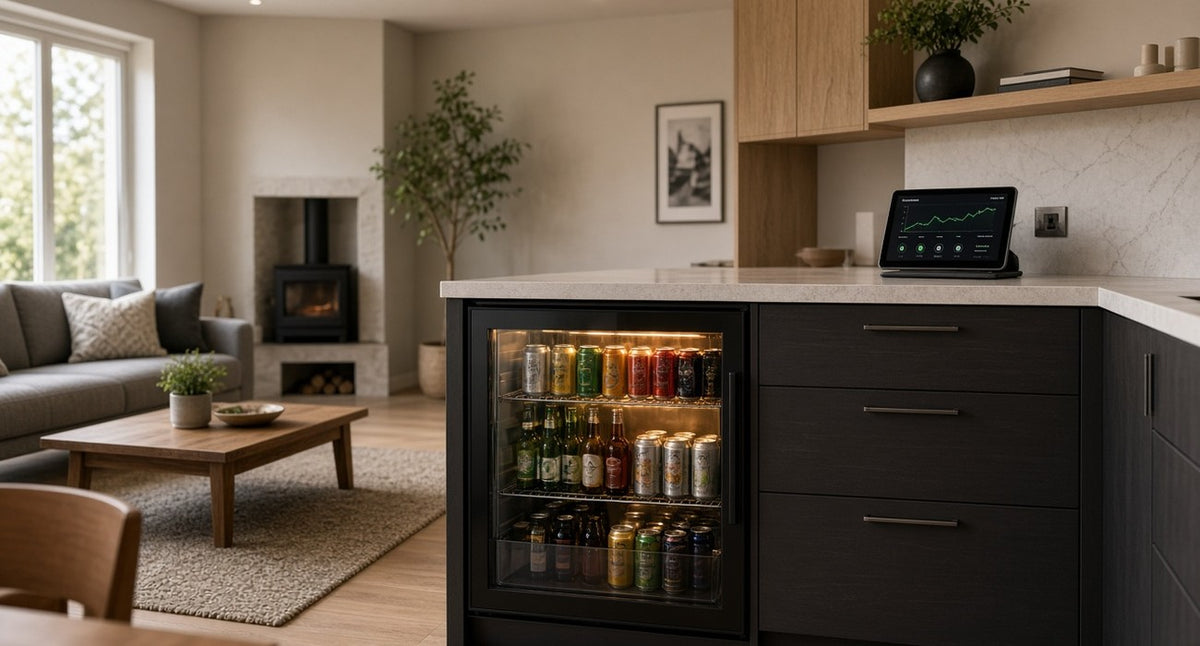
With energy bills still front of mind for UK households, one of the most common questions we hear is simple: how much will a mini fridge cost to run? The good news is that modern compact fridges are far cheaper to run than most people expect. In this guide we explain how to read the energy figures, show you a quick formula for your own tariff, and compare the listed annual consumption across the Subcold and Barcool ranges.
How to Work Out Running Costs
Every fridge sold in the UK shows its annual energy consumption in kWh per year on its energy label, taken from the official EPREL product database. To estimate your annual running cost:
Annual cost = kWh per year × your unit rate (pence per kWh) ÷ 100
For example, a fridge using 80 kWh per year on a tariff of 25p per kWh costs about £20 a year, or roughly 38p a week. Unit rates vary by supplier, region and tariff, so check your latest bill and plug in your own figure. Our examples below use 25p/kWh purely for illustration.
Listed Annual Energy Use Across the Subcold Range
The figures below are taken from current subcold.com product listings and the energy labels supplied with each model. Real-world use depends on room temperature, thermostat setting and how often the door is opened.
| Model | Cooling type | Listed kWh/year | Approx. cost/year at 25p |
|---|---|---|---|
| Super35 | Compressor | 48 | £12 |
| Super50 | Compressor | 60 | £15 |
| Super65 | Compressor | 77 | £19.25 |
| Aire20 | Thermoelectric | 75 | £18.75 |
| Aire30 | Thermoelectric | 76 | £19 |
| Aire40 | Thermoelectric | 76 | £19 |
| Cave35 | Compressor | 76 | £19 |
| Cave50 | Compressor | 80 | £20 |
| Cave60 | Compressor | 80 | £20 |
| Cave90 | Compressor | 85 | £21.25 |
| Ace65 – Ace130 | Compressor | 77–79 | £19.25 – £19.75 |
| Apex70 / Apex95 | Compressor (IPX4) | 79 / 81 | £19.75 / £20.25 |
| Eco100 | Compressor | 104 | £26 |
Ranges Where You Should Check the Energy Label
For some models the listed figure varies by colour, door type or production batch, so we always recommend checking the energy label image on the individual product page before you buy. That includes:
- Barcool BAR Series: the Barcool Bar25 LED, Barcool Bar30 LED, Barcool Bar40 LED and Barcool Bar50 LED. Barcool, a brand of Subcold Ltd, uses fanless heat-pipe thermoelectric cooling, so there is no compressor and no fan, and the cabinet runs at just 22–25 dB.
- Eco Series: the Eco50, Eco75 and Eco100 fridges with 0–8°C cooling for food and milk.
- Larger Super models: the Super85 and Super115 with digital thermostats.
- Viva wine coolers: Viva16, Viva20, Viva24 and Viva28.
- Personal coolers: Pro4, Pro6, Pro10 and Pro15, which are portable thermoelectric coolers powered by mains or 12V and typically used intermittently.
Does Thermoelectric or Compressor Cost More to Run?
It depends on the room and the size of the cabinet. Compressor fridges cycle on and off, using power only while the compressor runs. Thermoelectric fridges use a Peltier module that works continuously to hold the temperature below the room, so in a warm room they can use more energy relative to their size. In a cool, stable bedroom both are cheap to run. Learn more in our Thermoelectric vs Compressor Fridges guide.
Seven Ways to Cut Your Mini Fridge Running Costs
- Give it space. Leave ventilation gaps so the cabinet can shed heat efficiently.
- Keep it out of the sun and away from radiators, ovens and heaters.
- Set a sensible temperature. Drinks taste great at 4–7°C; you rarely need the coldest setting.
- Keep it reasonably full. Chilled cans and bottles act as thermal mass, so the fridge recovers faster after the door opens.
- Check the door seal. A sheet of paper should be held firmly when shut in the door.
- Defrost regularly on manual-defrost models; ice build-up acts as insulation and wastes energy.
- Switch off portable coolers when you do not need them.
Is a Mini Fridge Cheaper Than Using the Main Fridge?
A second fridge always adds some consumption, but a compact fridge in the right place can stop the main kitchen fridge from being overloaded and constantly opened. For a home bar, a dedicated beer fridge such as the Super50 keeps drinks at serving temperature without crowding out food. For bedrooms and guest rooms, a silent Barcool Bar30 LED or a tabletop Aire20 keeps drinks at hand for pennies a week.
Why Room Temperature Changes Your Bill
Energy labels are measured under standard laboratory conditions. At home, the single biggest factor is the temperature of the room. A fridge in a cool hallway at 16°C works much less than the same fridge in a sunny conservatory at 28°C, because every degree of extra warmth means more heat leaking through the cabinet walls and door seal. In summer, a beer fridge in a hot kitchen or garden room may run noticeably longer than in winter. That is why siting matters as much as the model you choose: a well-ventilated, shaded spot can shave pounds off your annual bill.
Door openings matter too. Each time the door opens, cold air spills out and warm, moist air rushes in. On a party day a drinks fridge can be opened dozens of times an hour, so loading it with pre-chilled drinks and keeping it well stocked helps it bounce back quickly.
Frequently Asked Questions
How much does a 50 litre beer fridge cost to run?
Based on the listed figures, a 50L compressor beer fridge such as the Super50 or Cave50 uses around 60–80 kWh per year: roughly £15–£20 a year at 25p/kWh.
Is it expensive to leave a mini fridge on all the time?
No. Fridges are designed to run continuously, and most of the Subcold models listed here cost around £12–£26 a year at our illustrative rate.
Do wine coolers use a lot of electricity?
A compact single-zone wine cooler uses a similar amount of energy to a mini fridge of the same size. Check the energy label on each Viva or Vino model for the exact figure.
Find an Efficient Fridge for Your Space
Running a mini fridge or beer fridge in 2026 typically costs less than a takeaway coffee a month. Compare the full range in our Complete Buying Guide, browse beer fridges, or explore our hotel-approved Barcool BAR silent mini bars.

Leave a comment
This site is protected by hCaptcha and the hCaptcha Privacy Policy and Terms of Service apply.